Cold Compression After Surgery: More Than Just Ice
Managing pain and swelling is an important part of orthopedic recovery. Combining cold therapy with intermittent compression may offer benefits beyond traditional ice packs.
6 min read · re: editorial · Published
If you're preparing for orthopedic surgery, you've probably thought about how you'll manage pain afterward. Your surgeon may have discussed medications, nerve blocks, physical therapy, and activity restrictions.
But what about the time you'll spend recovering at home?
Pain and swelling can make those first days uncomfortable. And while medication is often part of the plan, many patients are interested in additional ways to manage discomfort and potentially reduce their reliance on opioid pain medication.
One option worth understanding is cold therapy combined with intermittent compression.
Why cold therapy matters after surgery
Cold therapy, also called cryotherapy, has long been used in orthopedic recovery.
Cooling the surgical area can help reduce pain and discomfort. Depending on the procedure, it may also help manage swelling.
Traditional ice packs provide cooling, but they gradually warm as the ice melts. They also need to be repositioned and replaced throughout the day.
Circulating cold-therapy systems offer a different approach, delivering chilled water through a wrap designed for the treatment area.
But cooling is only part of the equation.
What does intermittent compression add?
Intermittent pneumatic compression uses a wrap that repeatedly inflates and deflates, applying controlled pressure around the treatment area.
Unlike a static compression bandage, intermittent compression creates cycles of pressure and release.
This approach is designed to support fluid movement and help manage postoperative edema, or swelling.
When combined with circulating cold therapy, the two treatments work together:
- Cold therapy helps manage postoperative pain and discomfort.
- Intermittent compression applies controlled, cyclical pressure to the treatment area.
- Together, they provide an integrated approach to postoperative pain and swelling management.
For patients recovering from orthopedic procedures, this combination may offer advantages over traditional icing alone.
Can cold compression reduce the need for opioid medication?
This is one of the more interesting areas of clinical research.
Opioid medications may be prescribed after orthopedic surgery, but they can cause side effects, including nausea, constipation, sedation, and dependence.
That makes non-opioid approaches to postoperative pain management especially valuable.
Clinical studies have investigated whether combining cold therapy with compression can help patients manage discomfort while using less opioid medication.
In a multicenter, unblinded randomized trial involving 200 shoulder-surgery patients, reported in a 2024 conference abstract, those assigned to a Game Ready cold-compression system used significantly less opioid medication than patients receiving standard care.
Median opioid consumption was approximately 50% lower in the Game Ready group.
The study also reported better physical function at two weeks. Pain scores themselves were not significantly different between groups, and the difference in time to stopping opioids was not statistically significant.
Other orthopedic studies have reported reductions in pain or medication consumption with cold-compression therapy, although findings vary across procedures.
The takeaway: Cold compression may be a useful part of a multimodal pain-management plan, potentially helping some patients reduce opioid use without replacing prescribed medications or other recommended treatments.
How is Game Ready different from an ice pack?
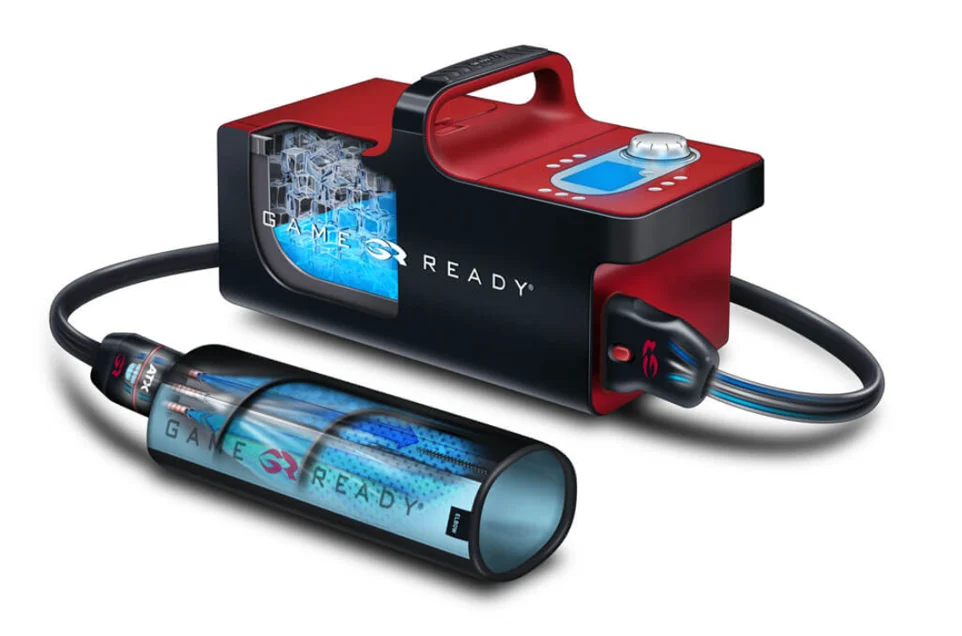
Game Ready's GRPro 2.1 system combines circulating cold therapy with intermittent pneumatic compression.
Its anatomically designed wraps provide coverage around areas such as the shoulder, knee, hip, and ankle.
Instead of repeatedly applying a melting ice pack, patients use a system that circulates chilled water through the wrap while delivering controlled compression cycles.
Key features include:
- Consistent circulating cold therapy
- Adjustable temperature settings
- Intermittent pneumatic compression
- Wraps designed for specific treatment areas
- A system that can be used at home according to the prescribed treatment plan
For patients recovering with limited mobility, having both therapies in one system can also make the treatment routine more convenient.
What does the clinical research show?
Game Ready has been studied across several orthopedic procedures, including knee arthroplasty, ACL reconstruction, hip procedures, and spine surgery.
Research has reported potential benefits involving postoperative pain, swelling, opioid consumption, and patient experience.
Not every study has demonstrated an advantage over conventional icing, and results from one procedure shouldn't automatically be applied to another.
Still, the evidence provides a meaningful reason to discuss cold-compression therapy with your surgical team, particularly if you're interested in a recovery plan that incorporates non-opioid pain-management strategies.
Can you rent Game Ready for home recovery?
Yes. Game Ready systems are available through rental programs, making the technology accessible without purchasing a unit.
If you're interested, it's worth exploring your options before surgery so you have time to understand the equipment, arrange delivery, and review safe-use instructions.
Explore Game Ready rentals
Interested in using cold therapy and intermittent compression during your recovery?
Learn more about Game Ready and request information about renting a system for home use.
Your surgical team can help determine whether cold-compression therapy is appropriate for your procedure.
re: may receive compensation from partner referrals. Rental availability, pricing, and eligibility are determined by the provider.
A smarter approach to postoperative comfort
Recovery isn't about choosing between medication and other treatments. It's about building a plan that addresses pain, swelling, mobility, and the practical realities of being home after surgery.
Cold therapy and intermittent compression offer two complementary approaches that may help patients manage some of those early challenges.
If you're preparing for surgery, ask your surgical team whether a cold-compression system belongs in your recovery plan.
It's one more conversation worth having before surgery day.
Clinical references
- Game Ready. Clinical Evidence. Manufacturer's overview of studies involving GRPro 2.1 and related systems.
- Khan M, et al. Cryocompression Results in a Significant Decrease in Opioid Consumption following Shoulder Surgery – A Multi Center Randomized Controlled Trial. Conference abstract. Orthopaedic Journal of Sports Medicine. 2024;12(7_suppl2). Read the conference abstract.
- Waterman B, et al. The efficacy of combined cryotherapy and compression compared with cryotherapy alone following anterior cruciate ligament reconstruction. Journal of Knee Surgery. 2012;25(2):155–160.
- Su EP, et al. A prospective, multi-center, randomised trial to evaluate the efficacy of a cryopneumatic device on total knee arthroplasty recovery. Journal of Bone and Joint Surgery. British Volume. 2012;94(11 Suppl A):153–156.
Follow your surgeon's instructions and the device manufacturer's safety guidance. Cold compression may be inappropriate for patients with certain vascular, circulatory, or sensory conditions. This article is educational and does not replace medical advice. Do not change prescribed pain medication without discussing it with your care team.

